On the night of April 8, through Pakistani mediation, the United States and Iran agreed to implement a two-week ceasefire regime. US President Donald Trump announced the truce just hours before the expiration of an ultimatum to Tehran to open the Strait of Hormuz and strike a deal with the United States. According to Trump, the key condition of the ceasefire was the "full, swift, and safe opening" of the Strait of Hormuz. Iranian military authorities confirmed they would ensure the passage of ships through the strait during this period.
Israeli Prime Minister Benjamin Netanyahu expressed support for the US decision to halt strikes on Iran but stated that the two-week ceasefire "does not include Lebanon." This directly contradicted Pakistani Prime Minister Shahbaz Sharif's assertion that the ceasefire regime "applies everywhere, including Lebanon." That same day, Israel launched attacks on Lebanon, which it termed its "strongest strikes," resulting in at least 357 deaths.
On the first day of the ceasefire, the Strait of Hormuz remained largely blocked, with only five ships passing through (prior to the war's start on February 28, up to 110 ships per day transited the strait). It is speculated that Iran was unable to open it due to failure to locate some of the mines laid in the strait. Tehran also accused the US and Israel of violating the ceasefire regime over the attacks on Lebanon.
On April 11, peace talks between the US and Iran commenced in the Pakistani capital, Islamabad. The US delegation was led by Vice President JD Vance, and included Trump's special envoys Steve Witkoff and Jared Kushner. The Iranian delegation was headed by Parliament Speaker Mohammad Bagher Ghalibaf and Foreign Minister Abbas Araghchi. The sides' consultations lasted 21 hours, but no agreement was reached.
JD Vance stated that the US and Iran failed to reach a deal. According to him, Washington's main task was to obtain a "firm commitment" from Tehran not to develop nuclear weapons, but "the Iranians decided not to accept their terms." Another White House condition was the full opening of the Strait of Hormuz. Iran, in turn, declared that the talks had reached an impasse due to "excessively high" demands imposed by the US.
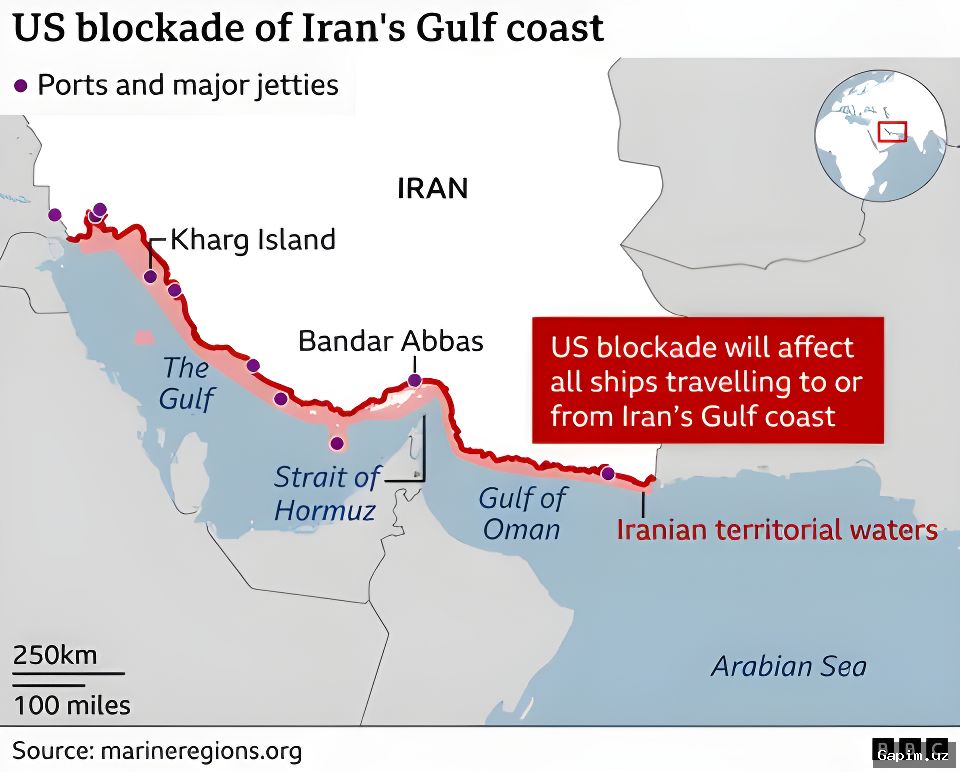
Following the failed negotiations, Donald Trump announced the start of "blocking all ships without exception attempting to enter Iranian ports." The US Navy began a blockade of Iranian ports in the Persian and Oman Gulfs. Iran labeled this "piracy" and warned that if Iranian ports were threatened, no port in the region "would be safe."
On April 14, talks were held in Washington between Israeli and Lebanese diplomats. This marked the first such meeting between the two states in over thirty years. The US participated as a mediator in these talks. Israel and Lebanon, with US mediation, reached a 10-day ceasefire agreement effective from April 17.
In response to the temporary truce between Israel and Lebanon, Iran opened the Strait of Hormuz to all commercial vessels until the end of the ceasefire period with the US. Donald Trump praised this decision, but Tehran stated that the US blockade of Iranian ports would remain in force until a deal was struck with Washington.
As the US refused to lift the blockade of Iranian ports, Iran re-closed the Strait of Hormuz. "Until the US restores full freedom of navigation for vessels exiting and entering Iran, the status of the Strait of Hormuz will remain under strict control and in its previous state," the Iranian armed forces declared.
The US Navy seized the cargo ship Touska, which attempted to breach the US blockade of Iranian ports. Iranian officials called the vessel's seizure a violation of the ceasefire and promised retaliation. Simultaneously, Donald Trump announced on April 22 the start of a new round of talks in Pakistan. He again threatened to destroy all power plants and bridges in Iran if Tehran refused to make a deal.
Donald Trump announced that, at Pakistan's request, he had extended the ceasefire regime with Iran until Tehran presented its peace proposal and talks concluded. He emphasized that the US would continue the blockade of Iranian ports. The Iranian leadership refused to participate in the second round of talks. The Iranian side cited the US violation of the ceasefire regime and the excessively harsh conditions Washington was imposing for peace as reasons.
The United Kingdom Maritime Trade Operations (UKMTO) reported attacks on two container ships in the Strait of Hormuz. According to UKMTO, in one incident, Iranian military forces fired upon a vessel. The UK and France are holding a meeting in London with military planners from over 30 countries. The two-day summit is dedicated to developing a plan to ensure security in the Strait of Hormuz and restore shipping.
Source: www.gazeta.uz