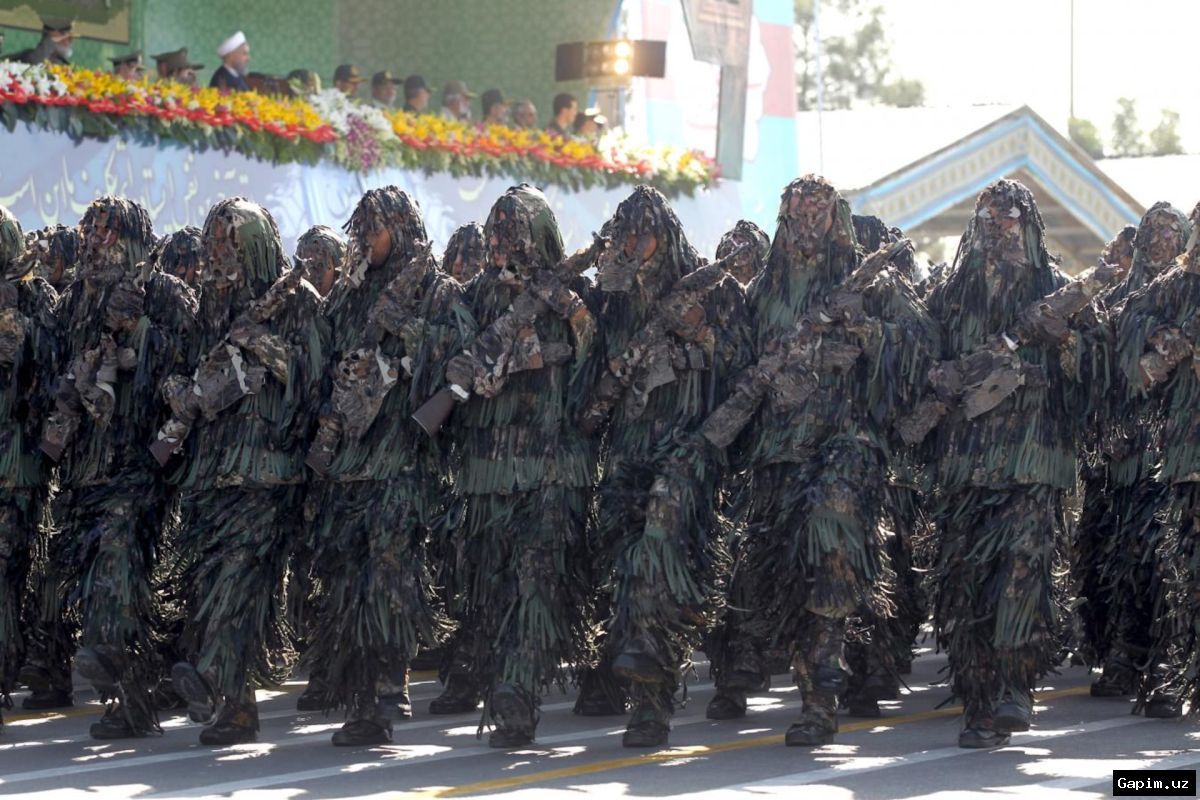
Military parades took place on the streets of Tehran, coinciding with the slated end of a two-week ceasefire that US President Donald Trump has extended for an unspecified period. State media and Iran's military leadership say they are prepared for a resumption of war with the United States and Israel, signaling opposition to any major concessions during negotiations.
In Enghelab (Revolution) Square, a Khorramshahr-4 ballistic missile, one of Iran's longest-range projectiles, was moved through crowds of supporters. In Vanak Square, masked men with assault rifles stood atop a truck-mounted launcher for a Ghadr missile amid chants of "Death to America". Addressing Islamic Revolutionary Guard Corps (IRGC) aerospace chief Seyyed Majid Mousavi, some chanted "Plough Tel Aviv," calling for more missile strikes against Israel.
State television and affiliated media outlets released footage and interviews with armed individuals, including women, who stated they were ready to fight on the streets. Images of pink missiles, drones, and assault rifles were circulated to emphasize women's support for the state's conflict stance. In an apparent effort to project unity, many women in state messaging do not conform to strict Islamic hijab standards enforced by the authorities.
State television has adopted a hardline approach toward negotiations with the US, with presenters advocating military strength in response to threats and ultimatums from Trump. A host claimed, without citing a source, that 87% of Iranians would prefer returning to war over making major concessions. The IRGC-linked Fars news agency released an AI-generated video showing an angry Trump and his team waiting for Iranian negotiators, then humiliated by the ceasefire extension.
Iran's military authorities continue to broadcast messages of resilience. The Khatam al-Anbiya Central Headquarters stated that armed forces have their "fingers on the trigger" to respond to any aggression with stronger attacks, while the IRGC reported seizing two vessels in the Strait of Hormuz for lacking permits. Mousavi warned neighboring countries that if their territories are used for attacks against Iran, "they must say goodbye to oil production in the Middle East."
Parliament Speaker and head of the negotiation delegation Mohammad Bagher Ghalibaf echoed that the establishment will not "surrender" to Trump, but acknowledged, "We are not stronger than the US in military power. They have more money, equipment, and facilities." He framed negotiations as a "method of fighting." Relative moderate President Masoud Pezeshkian also ruled out capitulation but expressed a desire to stop the fighting, stating it benefits no one.
Trump allegedly justified extending the ceasefire by claiming the "Government of Iran is seriously fractured" and unable to present a unified proposal, adding that "Iran is collapsing financially." Hardline judiciary chief Gholam-Hossein Mohseni-Ejei responded that the "enemy is not in a position to set a time for us." Influential Sunni leader Abdolhamid Ismaeelzahi called for a "fair agreement" as the only way out of the deadlock, citing occupied airspace, near-destruction of infrastructure, and lack of air defense means.
Source: www.aljazeera.com