The desiccation of the Aral Sea has become not only a regional but a global environmental disaster. On April 22, the Regional Ecological Summit in Astana discussed climate change impacts, water scarcity, land degradation, and intensifying desertification in Central Asia.
Uzbekistan proposed granting regional status to the Center for Combating Desertification and Drought Prevention under Green University. The center aims to consolidate scientific potential and create a robust monitoring system for salt-dust emissions from the dried seabed.
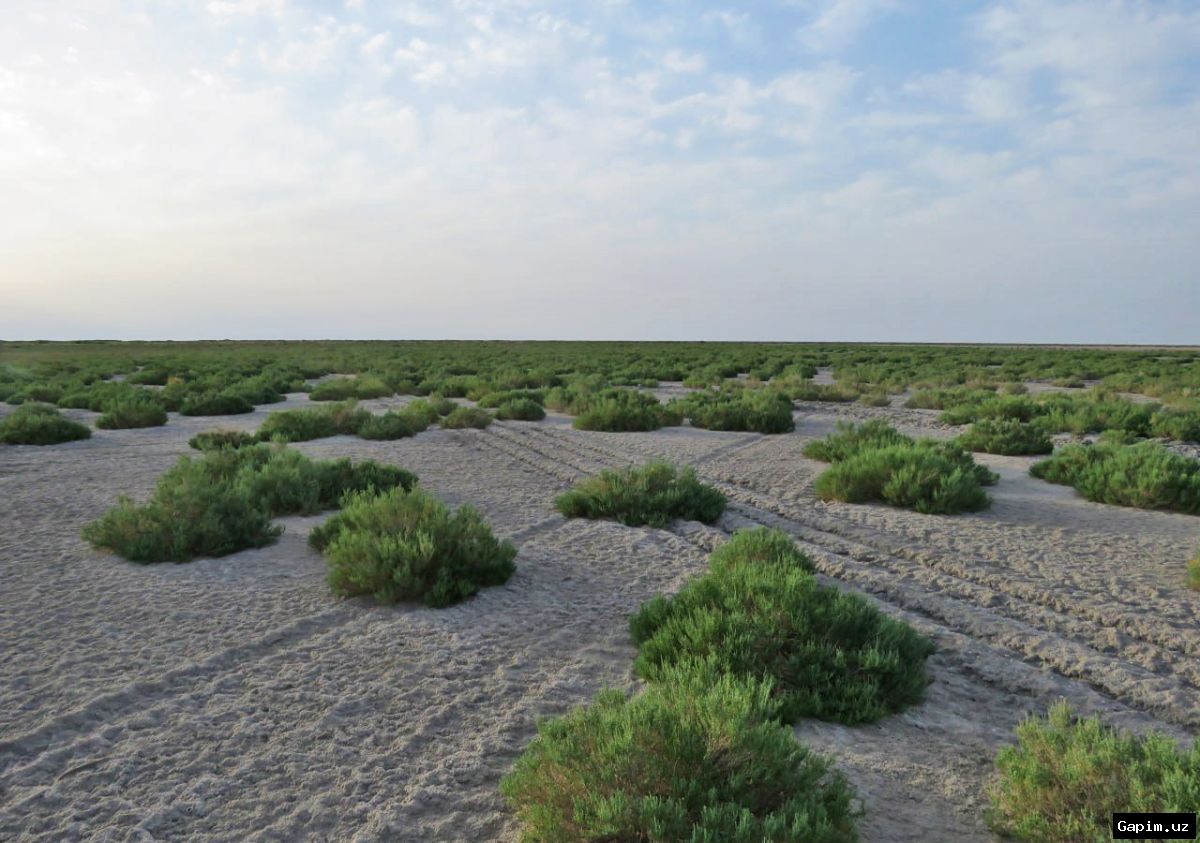
According to estimates, up to 150 million tons of salt, dust, and sand are lifted annually from the dried Aral seabed covering about 6 million hectares. These masses travel up to 1,000 km, falling as salty rain and snow, damaging cities, agriculture, and human health. The main sources are soft and partially crusted salt marshes covering about 450,000 hectares.
Over the past two years, the plant Arundo donax (giant reed), resistant to soil and groundwater salinity, has been successfully tested. In spring 2026, Uzbek foresters planted 115,000 hectares of protective forests. In total, over 2 million hectares of forest plantations have been established.
Uzbekistan plans to cover 80% of the dried seabed with vegetation by 2030. One hectare of four-year-old saxual absorbs 1,158.2 kg of CO2 and releases 835.4 kg of oxygen, contributing to mitigating global warming.
Experts predict that by 2040, water scarcity in the Aral Sea basin could nearly double to 20 billion cubic meters per year. Forest belts placed perpendicular to prevailing winds reduce evaporation by 40% and increase relative air humidity by 30%.
President Shavkat Mirziyoyev previously introduced the term “desert economy,” implying a scientific approach to desert development and deriving dividends. The dried seabed, covering 3.2 million hectares, should become a basis for pasture livestock, beekeeping, medicinal plant cultivation, and ecotourism.
However, large-scale gas exploration and extraction on the dried seabed are destroying the fragile ecosystem. Heavy machinery wheels crush vegetation. It is necessary to balance afforestation with industrial activities.
Academician Zinoviy Novitsky proposed six specific measures: create a unified monitoring system, develop an interstate program to combat the ecological crisis, inventory forest plantations, establish a regional center for growing fodder plant seedlings, implement a cluster approach, and promote ecotourism.
Novitsky, who has worked on the dried seabed for over 40 years, believes afforestation is the only real solution to the Aral problem. He hopes his proposals will be heard.
Source: www.gazeta.uz