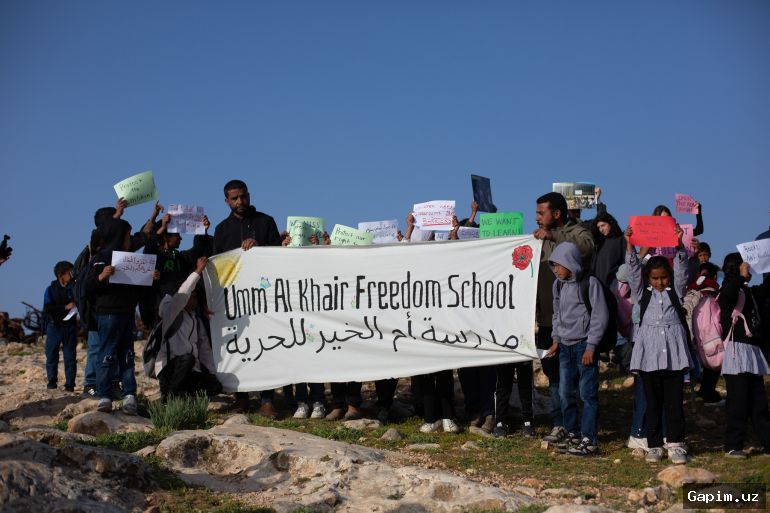
In the village of Umm al-Khair in the occupied West Bank, five-year-old Masa Hathaleen and her peers stood before a barbed wire fence blocking their path to school. Masa pleaded, "I am Masa, please open the road for us. We want to go to school. We are not doing anything wrong, we just have our books. We love our school." These children, with book bags in hand, marched on Sunday morning toward the barrier that now blocks the route used for decades to reach their school in the Israeli-occupied West Bank. They held up posters, sang songs, and chanted in English: "Open the road!"
For residents of Umm al-Khair, located in Area C of the West Bank under full Israeli control, the school path had been closed for over 40 days. After a ceasefire allowed schools to reopen, children found the path blocked by barbed wire a kilometer away. When children tried to go around the fence, soldiers launched tear gas and sound grenades at children as young as five. Khalil Hathaleen, head of the village council, stated, "It was a very violent situation. Until now, some children haven't returned due to fear. They can't sleep."
Security camera footage recorded by community members shows the fence was erected overnight by Israeli settlers. Despite lacking legal authorization, soldiers have refused to remove the barrier. Umm al-Khair also faces imminent demolition orders from Israeli authorities later this month due to a lack of building permits, which are almost never granted to Palestinians in Area C. After the fence went up, settlers built a large Star of David with stones on the side Palestinian schoolchildren can no longer access.
Desperate to get their children back to school, the community launched Sunday's march as part of a new initiative, "the Umm al-Khair Freedom School." Parents, teachers, and community members walked alongside children holding a banner declaring "Umm al-Khair Freedom School." On the other side, several Israeli soldiers stood watching, at times waving mockingly and mimicking children's songs along with a security guard from the adjacent illegal Israeli settlement of Carmel, which villagers said erected the barrier.
According to Khalil Hathaleen, the path was established in 1980 and is recorded as a designated pedestrian route for students on both Israeli Civil Administration and Palestinian maps. It also served women walking to a nearby health clinic and worshippers heading to a mosque, which they now cannot access. Since the fence was erected, Israeli authorities have offered an alternative, longer route roughly 3 km in length, but residents unanimously rejected it as it would force children to pass through new settler outposts erected next to their community. Under international law, Israeli settlements and outposts on occupied land are illegal.
Last summer, Awdah Hathaleen was killed in the area. Internationally sanctioned settler Yinon Levy was arrested and charged in his fatal shooting. Levy worked to clear land in Umm al-Khair to prepare for caravans that now sit directly behind the village's community center and family homes. Even after being filmed shooting Awdah Hathaleen, Levy kept returning to complete land-clearing work. Dangers in the area have only grown since. Eid Hathaleen, a parent of three school-age children, said settlers have scattered wooden planks with protruding nails along the roadside, damaging cars. Settlers' vehicles, sometimes driven at speed by teenagers, move unpredictably through the area.
Last month, five-year-old Siwar Hathaleen was struck by a settler's car while crossing through Umm al-Khair. She survived but was hospitalized with a head injury. Now, with the army refusing to remove the barbed wire fence, Eid Hathaleen has struggled to find solutions for his children. He said, "You feel useless that kids can't reach their school because of this blockade. The kids try to show their voice, try to make the best of the situation, but they're frustrated. They do some lessons at home, but it's not enough."
Ten-year-old Mira Hathaleen, daughter of Khalil, said at the Sunday protest she wants to be a doctor. She reasoned, "If I want to be a doctor, I must learn and have knowledge." But blocked from school by a fence guarded by soldiers, the situation seemed unjust: "We are children like the children of the rest of the world. They go to school, and we don't. Why?"
The community also faces looming demolition orders affecting nearly the entire village. Khalil Hathaleen appealed to human rights organizations and international observers to intervene, framing both struggles—blocking the school road and demolition orders—as part of the same campaign by settlers and Israeli authorities to erase the community of Umm al-Khair, which sits on the same hill as the illegal Israeli settlement of Carmel. Khalil said until the path to school is reopened, the community will hold daily peaceful demonstrations with lessons, music, and activities conducted outdoors at the blockage site. He stated, "We will do all the teaching in the sun. This is the only way. If we stay silent, no one will hear us."
Source: www.aljazeera.com