Communist Party chief To Lam was elected as Vietnam's new president this month following a unanimous vote in the National Assembly. This move notably goes against informal norms that have long shaped elite politics in Hanoi, where for decades, the Vietnamese Communist Party (VCP) has avoided concentrating too much power in one individual's hands.
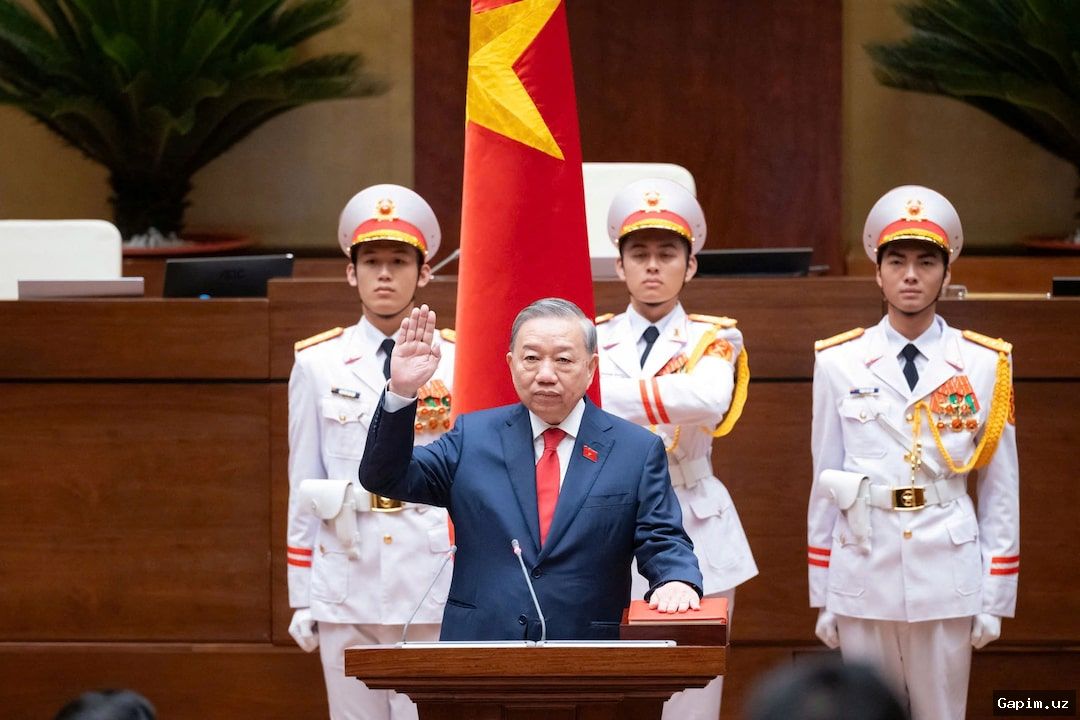
Vietnam's political system has traditionally relied on a so-called "four pillars" model, with authority divided among the party chief, state president, prime minister, and National Assembly. While not a full-fledged separation of powers as in liberal democracies, this arrangement created a measure of internal balance within the confines of one-party rule and helped reduce the risk of one person dominating the system. However, analysts suggest that To Lam's election to both posts may shift this balance.
Alfred Gerstl, an expert on Indo-Pacific international relations at the University of Vienna, stated that this step brings Vietnam's political system closer to China's, which is dominated by President Xi Jinping. Gerstl added, "Given his concentration of power, To Lam may be able to implement his ambitious reforms more quickly, but there is a risk that the established checks and balances will cease to function and that dissenting opinions within the party will be heard less and less."
In recent years, Vietnam has seen a bending of guardrails such as retirement-age norms. For instance, former party chief Nguyen Phu Trong secured a third term in 2021, breaking the long-observed two-term norm. To Lam, a former public security minister, rose as a key enforcer of Trong's anti-corruption campaign, which removed hundreds of officials and helped reorder the political hierarchy.
Under To Lam, Vietnam is also showing greater interest in elements of China's security and surveillance model. Gerstl argued that this trend "goes hand in hand with new bilateral agreements and would further restrict freedom of expression in Vietnam." The country is planning to establish state-run data-trading exchanges overseen by the public security ministry, "mirroring China's centralized data model," according to a Reuters report. Additionally, Vietnam is expanding a national electronic identification system, enabling authorities to identify individuals through AI camera networks—another parallel with China.
To Lam's first official diplomatic trip was to China, following a tradition set by previous Vietnamese leaders and Hanoi's official stance that views the two countries as socialist "comrades and brothers." During the visit, Xi Jinping stressed ideological solidarity and strategic coordination, with Chinese state media reporting that Xi described defending socialism and Communist Party rule as a shared strategic interest of both nations. Security was also high on the agenda, as Vietnam's public security minister, Luong Tam Quang, separately met three of China's top security officials, suggesting deepening ties in the institutions both systems rely on for political control.
Still, there are clear limits to the comparison with China. Hunter Marston, a non-resident fellow with the Institute for Global Affairs, noted that Vietnam has not attempted "Xi Jinping's Stalinist elimination of senior generals and the pervasive state of fear that Xi has injected into Chinese society more broadly speaking." He added, "Vietnam is far from a progressive democracy, but it lacks some of the totalitarian repression that China relies on more regularly for the Chinese Communist Party and Xi Jinping's political survival." In other words, while Vietnam remains an authoritarian one-party state, it has not built the same level of all-encompassing repression, ideological control, or cult of personality seen under Xi, and To Lam has yet to demonstrate he can dominate the system to the same extent.
Now, with To Lam ruling as both party head and president, the country's future will depend on how he wields his new, broader powers. If Lam governs pragmatically, supporters may see the merger of the two posts simply as a way to push through reforms more quickly and give Vietnam's paramount leader a bigger formal role for international partners. But if the trend continues toward tighter repression, weaker internal restraints, and a stronger security state, Vietnam may begin to look less like the collective authoritarian system it once claimed to be and more like its giant northern neighbor.
Source: www.dw.com