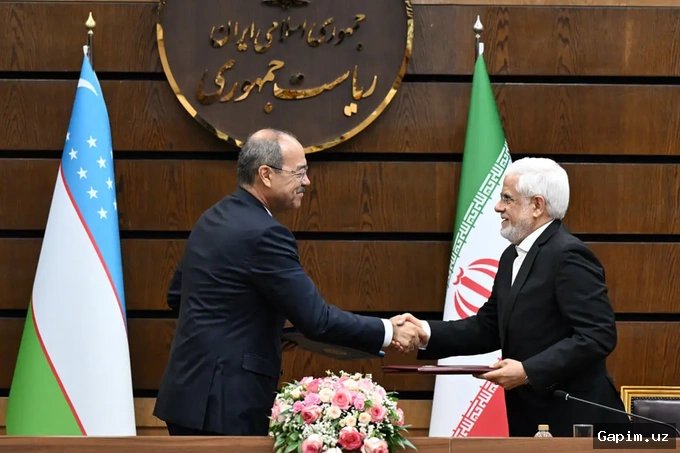
️ On March 4, at a press conference at the Iranian Embassy in Tashkent, Iran's Ambassador to Uzbekistan, Muhammad Ali Iskandari, responded to a journalist's question about how the acute situation in the region affects transport corridors.
️ According to the ambassador, despite various protests... and military tensions in the region, economic ties between the two countries continue to grow.
️ “We are fulfilling all our obligations to Uzbekistan. If there are any delays in Uzbekistan's export cargo somewhere, the least observed place is Iran. We are providing the greatest assistance to Uzbekistan in the transit of goods,” the diplomat emphasized.
️ Muhammad Ali Iskandari, addressing bilateral trade indicators, noted that by the end of 2024, mutual trade turnover between Uzbekistan and Iran amounted to $500 million, and in 2025, this figure exceeded $600 million.
️ He added that currently, the volume of cargo transportation is increasing significantly not only by rail but also by road transport.
️ “We defend ourselves to the best of our ability. Iran is also considered a major economic power. Despite such great pressure applied over the past 40 years, Iran remains one of the largest economic players in the region. Therefore, if Uzbek entrepreneurs have any requests or appeals to the Iranian government, for example, on issues of economic trade cooperation, we are certainly ready to fulfill them,” said Iran's Ambassador to Uzbekistan, Muhammad Ali Iskandari.
️ The ambassador also denied reports on the internet about the closure of the Strait of Hormuz, adding that it is operational.
️ “Only because of the war in the region, ships naturally comply with security measures when passing through it. Due to ongoing combat and considering the likelihood of various military provocations, states are taking precautionary measures when conducting their ships through this strait,” he said.
️ It is worth noting that Iran, which holds a strategic position in the global trade route system, has significant transit potential and logistical opportunities of interest to Uzbekistan.
️ A number of important international transport corridors pass through Iranian territory. These include: Central Asia — Bandar Abbas port (via Turkmenistan), Central Asia — Iran-Turkey, the southwestern corridor: Persian Gulf — Iran — Azerbaijan — Georgia (Poti port) — Ukraine — Poland, Iran — Turkey — Bulgaria — Romania — Germany, and others. Additionally, Tehran participates in three major projects — the International Transport Corridor (ITC) “North-South,” the Ashgabat Agreement, and the Chabahar port.
️ Transport Minister Ilhom Mahkamov stated that Uzbekistan's external transportation is carried out along nine international corridors, with one of the main ones being the southern corridor passing through Iranian seaports. Through it, a large part of exports and imports is carried out, including up to 60% of cargo from Turkey and Europe.
️ In January 2025, the head of the Ministry of Transport announced the identification of alternative corridors for passage along “problematic” routes. Among them were listed the following:
️ In June 2025, during the Iran-Israel war (“Twelve-Day War”), emergency measures were taken to ensure the stability of Uzbekistan's foreign economic transportation, prevent price increases, and ensure timely delivery of goods.
️ In particular, Mahkamov said that if problems arise with transportation through Iran, there is an opportunity to use ports in Pakistan, as well as to deliver products from Turkey via the Middle Corridor or through Georgia-Russia borders, with subsequent transportation via Russia-Kazakhstan.