Tashkent’s ‘Great Silk Road’ Intersection: Experts Propose Alternatives to Official Reconstruction Plan
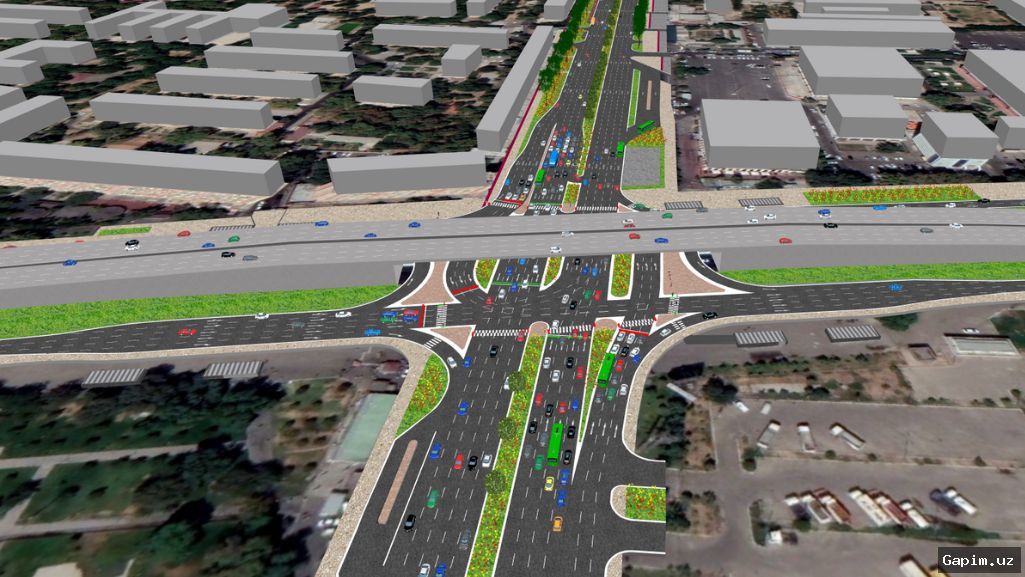
Urban planning experts Bobur Sirojev and Iskandar Soliev have developed alternative proposals for the reconstruction of a key intersection near the ‘Great Silk Road’ metro station in Tashkent, offering a counterpoint to the city administration’s plan to build a two-level flyover. Although their projects were prepared independently, both share similar ideas: keeping the intersection at ground level, enabling turns in all directions, and creating pedestrian-friendly features.
Bobur Sirojev, an expert in sustainable mobility and infrastructure, critically assessed the administration’s flyover proposal, highlighting the lack of open discussions, limited initial data, and insufficient detailing of adjacent areas. He argued that such major projects should involve specialists in the discussion stages, not just construction companies. Sirojev stated, “Tashkent has entered a development phase where old infrastructure reserves are almost exhausted. Now, we cannot simply get out of the situation by ‘building more’.”
The expert listed weaknesses in the administration’s project, including the preservation of left-turn bans, high costs for relocating utility lines, significant disruption to existing greenery, and the risk of congestion at neighboring intersections due to a lack of traffic flow regulation mechanisms. In the administration’s presentation, the intersection is labeled a “bottleneck,” with traffic capacity purportedly increasing by 130% through the flyover.
Sirojev’s alternative project, developed with transport engineer Aleksandr Devyatkin, maintains the intersection at ground level, providing access for all directions, including left turns. It envisions traffic flow regulation via “smart” traffic lights, priority for public transport, and restoration of connectivity with Muhammad Yusuf Street. Sirojev described this variant as “demonstrating the fundamental possibility of increasing efficiency without capital intervention.”
The expert emphasized the importance of using metrics like the Benefit-Cost Ratio (BCR) to reflect social benefits in decision-making. He noted that in countries traditionally focused on automobile transport, the emphasis is now shifting toward reducing total vehicle travel miles. Sirojev remarked, “Increasing the average speed of private transport does not automatically make the system sustainable. Without priority for public transport, such solutions only deepen car dependency.”
In conclusion, Bobur Sirojev stressed that the main criterion for urban development should not be maximizing individual indicators but achieving the highest social return per unit of funds spent. He argued that Tashkent cannot afford costly projects that fail to justify themselves, as the budget is not unlimited, and every dollar spent means forgoing other, sometimes more beneficial solutions for the city.
Source: www.gazeta.uz