Tashkent city authorities have decided to eliminate so-called bus 'pockets' at stops as part of a broader reconstruction of public transport infrastructure. Mirakbar Ikramov, head of the Main Department for Transport and Road Transport Infrastructure Development of Tashkent, confirmed the decision in an interview with the press service of the Toshshahartransxizmat company.
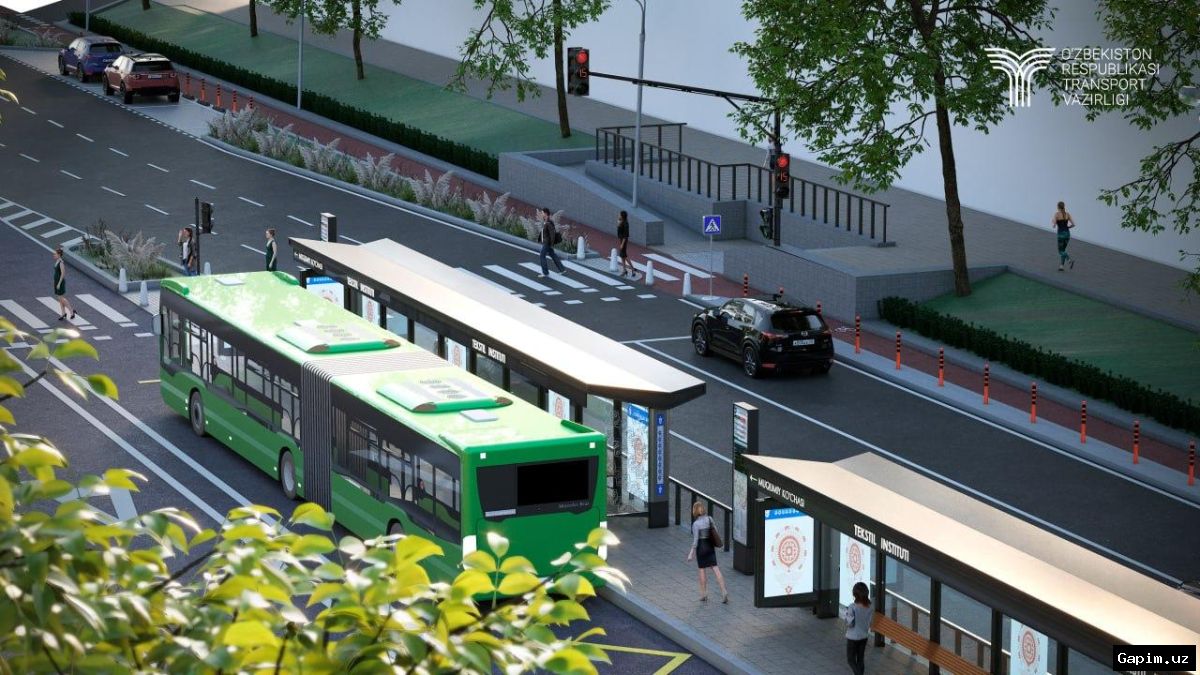
According to Ikramov, the primary goal is to ensure priority for buses. Entering and exiting the 'pockets' causes time losses, especially when other drivers fail to give way to buses, despite traffic rules requiring them to do so. This slows down public transport and reduces efficiency.
Another issue is that large articulated buses face difficulties maneuvering into and out of the 'pockets.' Car drivers often park illegally inside the pockets or on access lanes, creating additional hazards and sometimes causing minor accidents.
When multiple buses arrive simultaneously, they may not fit into the pocket. With increasing passenger numbers, there is a need to expand boarding platforms. Eliminating pockets will allow platform expansion, creating a safer environment for passengers, particularly children and the elderly.
Experts argue that contrary to popular belief, bus pockets are not convenient. They cite time loss, maneuvering difficulties, frequent traffic violations by other drivers, and risks to passengers. A single articulated bus carries up to 150 passengers, while a car typically carries one or two people — the priority should clearly be on public transport.
It has also been observed that some bus drivers, even with pockets available, do not stop close to the platform, forcing passengers to step onto the roadway. In rainy and snowy weather, pockets further complicate boarding and alighting.
In countries with developed public transport systems, bus pockets have long been abandoned. Many use 'anti-pockets' — convex platforms that extend into the roadway. This discourages drivers from stopping even briefly and narrows the road, enhancing safety.
Currently, Tashkent is also clearing bus stops of shops. As of March 1, out of 2,871 stops, 739 had shops, most of which were built illegally.
Source: www.gazeta.uz