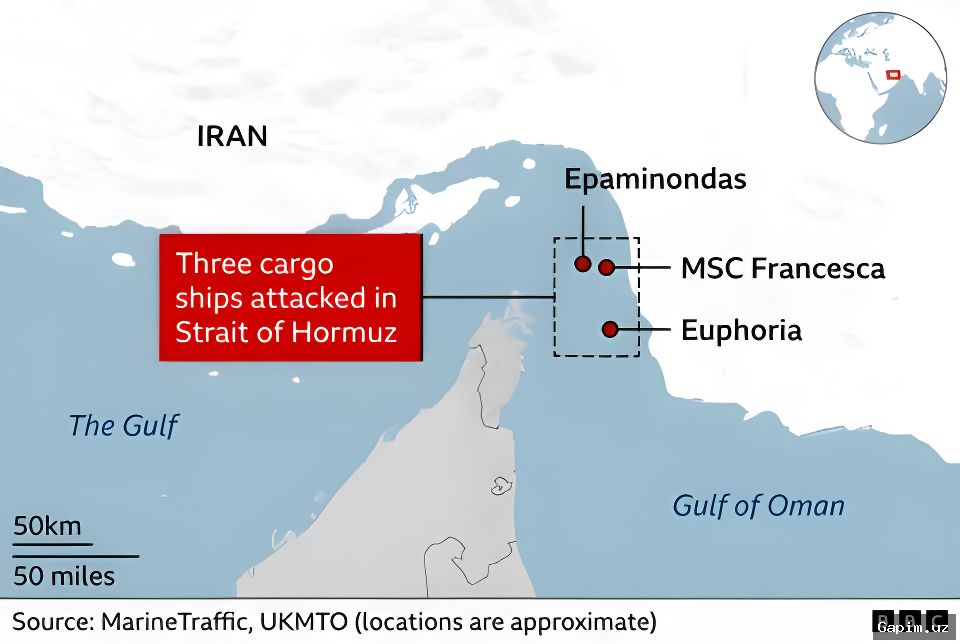
Iran reportedly captured two foreign container ships attempting to exit the Strait of Hormuz on Wednesday and fired on a third vessel, marking the latest escalation in the ongoing naval confrontation between the US regime and Tehran. The incident comes amid a US naval blockade of Iranian ports that began on April 13.
Earlier this week, the US military fired on and seized the Iranian-flagged container ship Touska near the strait, prompting Iran to accuse Washington of “piracy”. On Tuesday, the US allegedly intercepted three Iranian tankers in Asian waters, redirecting them away from positions near India, Malaysia, and Sri Lanka.
Although a ceasefire is supposedly in place, attacks and seizures by both sides indicate a continuing naval war in the strait, through which about 20% of global oil and LNG supplies transit during peacetime. Iran’s Foreign Minister Abbas Araghchi claimed the strait is closed only to “enemies” – the US and Israel – while other vessels may pass after coordinating with the Islamic Revolutionary Guard Corps (IRGC).
In March, the IRGC purportedly introduced a “toll booth” system, with at least two vessels paying fees in Chinese yuan. Iran’s oil exports through the strait account for 80% of its total exports. According to trade intelligence firm Kpler, Iran exported 1.84 million barrels per day (bpd) in March and 1.71 million bpd in April, compared to a 2025 average of 1.68 million bpd. At a conservative estimate of $90 per barrel, Iran earned at least $4.97 billion from oil exports in the past month – 40% more than pre-war monthly earnings.
Since the US blockade began, US Central Command claims to have redirected 31 Iran-linked vessels. Iran’s First Vice President Mohammad Reza Aref stated that “the security of the Strait of Hormuz is not free” and that foreign ships will not be allowed to pass until the blockade is lifted. He warned of “significant costs for everyone” if pressure on Iran continues.
Analysts view the ship seizures as a dangerous game of brinkmanship. Ali Vaez of the International Crisis Group described it as “mutual brinkmanship, with each side testing the limits of coercion”. Chris Featherstone of the University of York called it a “high-stakes game of poker”, with both sides waiting for the other to blink. Iran’s parliamentary speaker Mohammad Bagher Ghalibaf insisted that a full ceasefire requires lifting the US naval blockade, calling it a “flagrant breach” of the truce.
Source: www.aljazeera.com