US President Donald Trump last week announced plans to increase tariffs on cars and trucks manufactured in the European Union from 15% to 25%, accusing the bloc of dragging its feet on implementing a trade deal agreed last July.
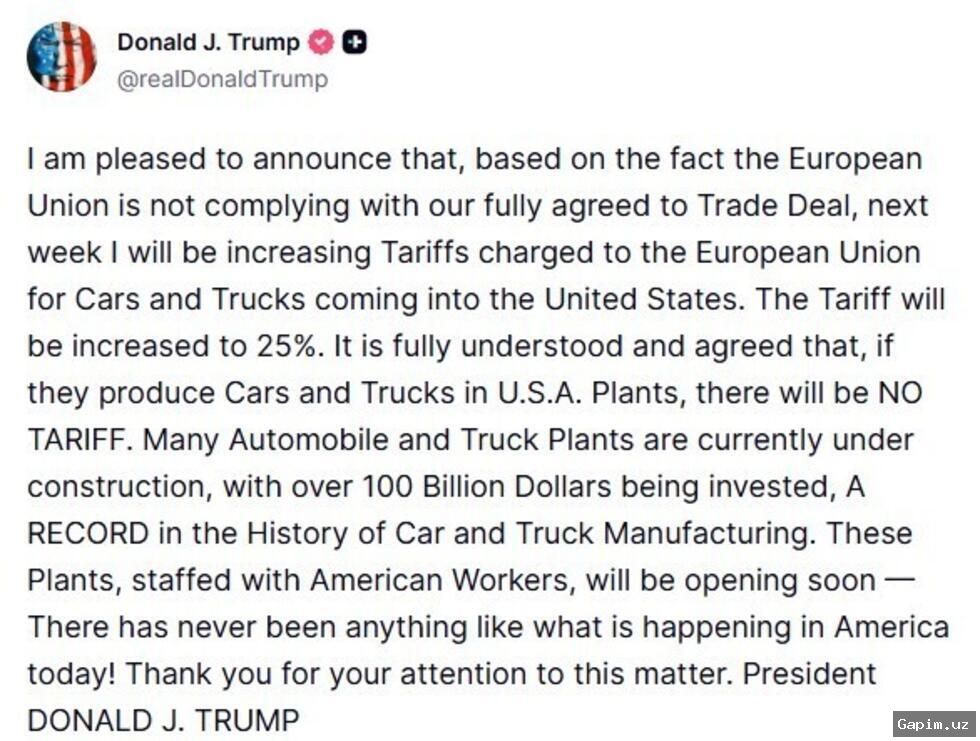
The latest trade salvo comes as transatlantic ties remain strained, with the EU's refusal to join Washington's war on Iran adding to the friction. Trump wrote on social media: “I am pleased to announce that, based on the fact the European Union is not complying with our full agreed to Trade Deal, next week I will be increasing Tariffs charged to the European Union for Cars and Trucks coming into the United States.” He provided no evidence for his claim.
The US president said vehicles made in the US by EU companies would be exempt. No additional tariffs have taken effect yet, but the move surprised Brussels. The European Commission rejected Trump's claim that the EU was not complying with last year's deal.
In July 2025, the US and EU reached a broad trade agreement capping US tariffs on most EU goods, including cars, at 15% after months of standoff. The EU also agreed to spend hundreds of billions of dollars on US weaponry and energy products. Trump hailed it as the “biggest deal ever made.”
German Chancellor Friedrich Merz, whose country is likely to be hit hardest by a car tariff increase, told broadcaster ARD: “The Americans have it finalised, and the Europeans haven’t – and that’s why I hope we can reach an agreement as quickly as possible.”
Indian international trade lawyers Shantanu Singh and Vikram Naik noted that before the EU-US deal, cars and car parts faced US import tariffs of up to 27.5%. The July deal set a tariff ceiling of 15%, making the car sector one of its biggest beneficiaries. “The threat of reversing those tariffs to 25% becomes quite significant commercially,” they said.
Peter Chase, senior fellow at the German Marshall Fund in Brussels, said Trump's announcement stems from impatience with the EU's lengthy procedures to implement the so-called “Turnberry Accord.” “We will not be able to gauge the significance of the president’s threat until it is finalised in an Executive Order,” he told Al Jazeera.
Camille Reverdy, affiliate fellow at Bruegel, said the EU has credible retaliation tools, including retaliatory tariffs on US goods and dispute settlement at the WTO. “Beyond trade policy responses, the EU is also likely to rely on industrial policies to support its automotive industry and promote market diversification outside the US,” she added.
Source: www.aljazeera.com