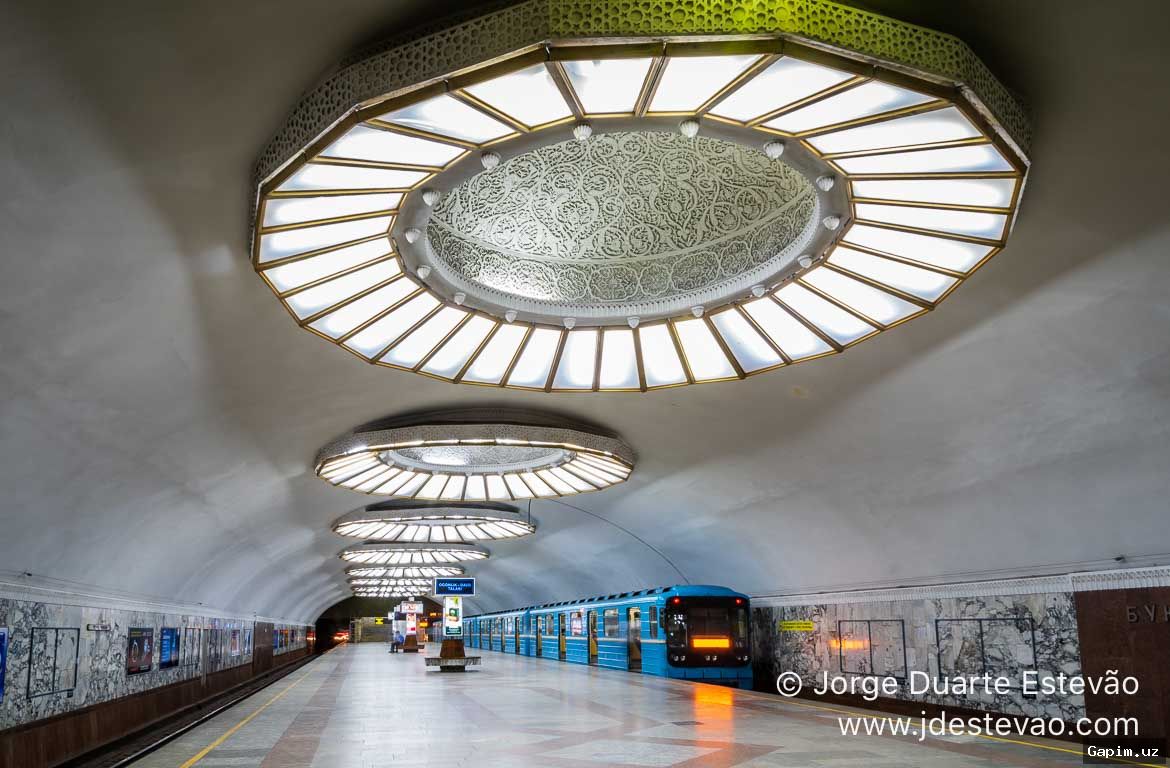
In Tashkent, a two-level automobile interchange is planned at one of the city's busiest intersections—near the 'Buyuk Ipak Yuli' metro station. The project was presented at a press conference by the Center for Road Traffic Organization (CRTO). The intersection of Mustaqillik Avenue, Mirzo Ulugbek Street, and Buyuk Ipak Yuli Street is considered a key 'bottleneck' in the capital, according to local authorities. Officials report that traffic jams regularly occur here, and during peak hours, movement is often manually regulated by traffic police.
According to the presented project, a multi-level interchange will be built at the site to ensure continuous traffic flow. Concurrently, a dedicated public transport line based on the BRT (Bus Rapid Transit) principle is planned for Mirzo Ulugbek Street. It will connect with existing and planned corridors along Mustaqillik, Shahrisabz, and Shota Rustaveli streets. Additionally, a tunnel is planned at the intersection of Mirzo Ulugbek and Durmon Yuli streets. Bahrom Shakirov, head of the 'Tashkent Invest' company, stated that the project aims to 'create conveniences for residents and city guests.' He noted that besides optimizing traffic flows, attention will be paid to pedestrian safety.
Authorities expect that the project's implementation will significantly improve traffic efficiency. According to specialists' calculations, the average travel time along the approximately 8-kilometer section from the Ts-1 residential area to the Small Ring Road (Timur Malik Street) will decrease by 25%—from 45 to 32 minutes during peak hours. The intersection's capacity is expected to increase by 21%, from 98,800 to 120,000 vehicles per day. The average speed will rise from 21 to 26 kilometers per hour. For public transport, a speed of up to 23 kilometers per hour is forecasted, which should ensure schedule adherence.
The project was developed with the participation of the Chinese company China Construction, in coordination with local specialized organizations. Artificial intelligence tools were used to analyze traffic flows and model movement. The final cost of the project is still being clarified, but it is known that financing is planned from the same investor who previously supported the reconstruction of Shota Rustaveli Street. The works also include a comprehensive 'facade-to-facade' reconstruction of Mirzo Ulugbek Street. Along the corridor, sidewalks will be updated, bicycle lanes created, benches installed, and greenery added. The authorities announced that approximately 8,000 square meters of green zones will be additionally created to compensate for transplanted trees. The main construction phase at the transport node, according to official estimates, will take 50 to 60 days. The project was presented as part of a public discussion attended by representatives of mahallas located along the future corridor.
However, the project has drawn criticism from urban planning perspectives. The multi-level interchange is primarily focused on automobile traffic, potentially marginalizing pedestrian and public transport needs. Such solutions often provide short-term relief but fail to address the root causes of network congestion, such as disrupted street connectivity and car-centric mobility priorities. During construction, significant traffic restrictions, additional strain on neighboring streets, and negative impacts on local businesses are anticipated. Moreover, the interchange could degrade the urban environment by reducing human scale and comfort for residents, highlighting tensions between modernization efforts and sustainable city development.
Source: podrobno.uz