Solar and wind power generate abundant energy, but not always at the right time. Europe needs more battery storage to stabilize prices and replace polluting fossil fuels, but significant roadblocks remain.
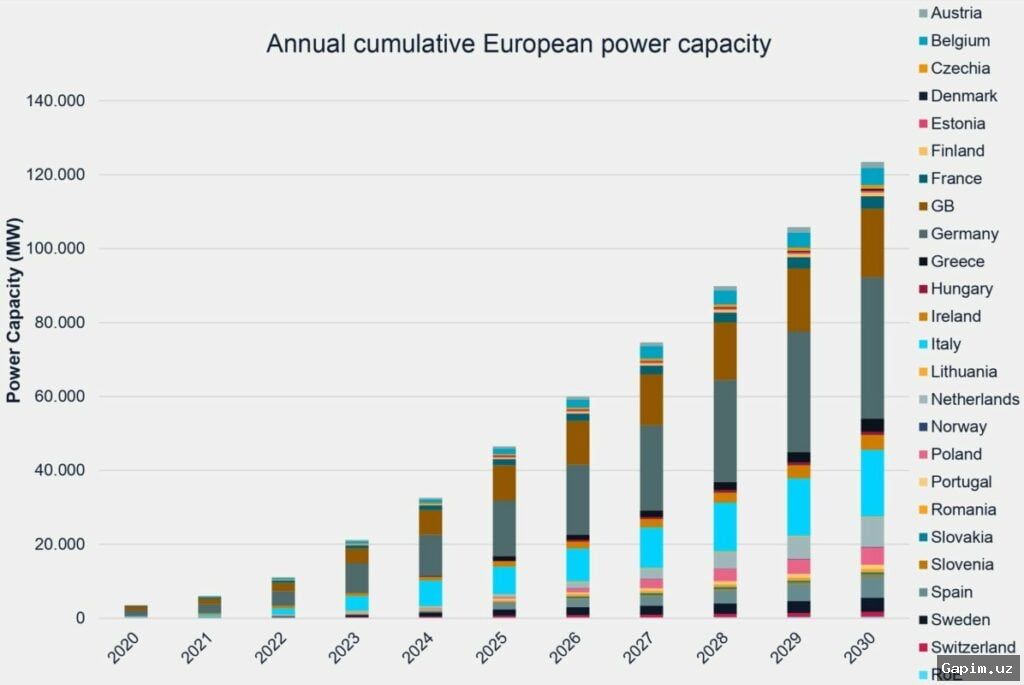
During the day, when wind and sun are abundant, electricity supply in Germany and other European countries often exceeds demand. However, insufficient battery storage makes it impossible to store this energy for later use. After sunset, natural gas plants typically fill the gap.
This must change if Germany aims to become climate-neutral by 2045. Large-scale storage facilities for green power are essential to keep electricity prices stable and enable a 100% renewable energy transition.
Currently, the EU—which targets climate neutrality by 2050—generates about half its electricity from renewables. Across Europe, existing storage capacity totals around 14 GW, according to the European Commission's Joint Research Centre.
Expansion has accelerated dramatically in recent years: an additional 84 GW of storage capacity (a sixfold increase) is in planning or construction and expected online soon. This mirrors a global trend, per Bloomberg New Energy Finance, with strongest growth in Asia, especially China and India. In Europe, Germany and Italy are major markets.
Rapid growth is partly due to falling costs. Lithium-ion battery prices have dropped about 20% annually in recent years. The EU forecasts battery costs will halve by 2030 compared to 2022.
Combining small private storage and large facilities, EU capacity has increased tenfold since 2022. But meeting the bloc's climate goals requires another tenfold increase to around 750 GW—a target still far off.
Renewable energy prices are particularly low during the day, sometimes dipping below zero due to oversupply from wind and solar. This forces some renewable plants offline temporarily, denting profits.
Dirk Uwe Sauer, a professor at RWTH Aachen University, explained that when gas and coal plants come online in the evening, prices spike. "Looking at last year's prices, around midday the average electricity price was barely €0.03, while in the early evening it was closer to €0.18," he told DW.
This price difference has made battery storage economically attractive, especially as natural gas prices surged due to wars in Ukraine and Iran. Sauer noted each additional storage unit helps moderate price spikes.
Until recently, renewable expansion in Europe was hampered by slow approval processes, long planning phases, and major obstacles connecting storage to the grid.
"Every year, we spend around €80 billion importing energy from abroad. That's a major dependency, and renewables can help break free," Sauer said. He emphasized that battery storage and grid buildout must be considered together.
Part of the problem is Europe's aging electricity grid. Many grids are over 40 years old and not designed to handle large amounts of green electricity. Grids in Germany and across Europe need modernization and connection to wind farms, solar farms, and storage.
The European Commission previously stated the EU needs about €580 billion in grid investments by 2030. But progress is mixed, even in Germany. The federal government has planned 16,000 km of power lines for years; only 20% is operational. However, permitting has recently been streamlined.
While investment in grid improvements is accelerating, the €580 billion goal looks unlikely. Data from the EU Agency for the Cooperation of Energy Regulators shows about €35 billion invested in 2024, expected to reach €47 billion by 2027.
Industry analysts do not expect the ongoing war in Iran to significantly impact battery sector growth, despite global energy turbulence. Bloomberg BNEF reports minimal impact so far, as most battery storage is based in China. The war has pushed electricity prices up due to fossil fuel shipments stuck in the Strait of Hormuz, potentially boosting short-term profits for storage operators. But Sauer said this is insufficient for sustainable growth.
"Temporary crises like Iran are generally not a good basis for investment decisions on products that will be used for many years," he said. Despite increased investment, he sees market uncertainty.
By the time large-scale facilities planned today are built and connected, the Iran war and energy crisis will be long over, Sauer noted. Governments need long-term goals. "Electricity grids are built for the next 40 or 50 years."
Alongside political will, EU member states need access to lithium and other metals for battery production. The bloc prioritizes raw materials strategy, supporting domestic rare earth production, reducing dependence on China, and developing secure supply chains. It also promotes recycling of critical raw materials like lithium, nickel, gallium, and cobalt.
Source: www.dw.com