In the first quarter of 2026, the European Union increased imports of Russian liquefied natural gas (LNG) to 6.9 billion cubic meters. This is 16% higher than the same period last year and the highest quarterly figure in recent years, according to analysts at the Institute for Energy Economics and Financial Analysis (IEEFA) in the United States.
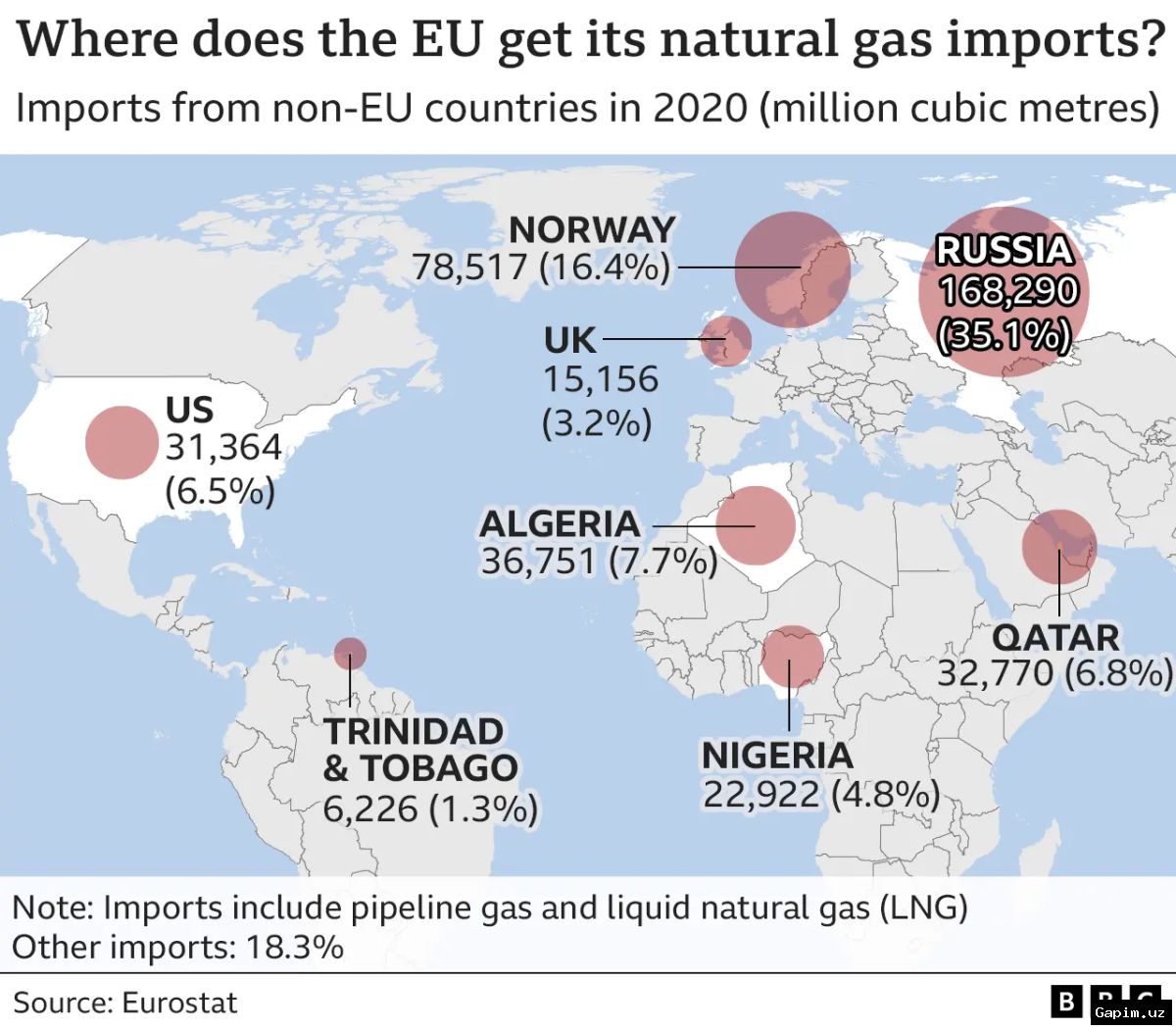
The IEEFA report notes that Russia remains the second-largest LNG supplier to the European Union. The top supplier is not specified. Key recipients of Russian LNG in Europe are France, Spain, and Belgium, with France leading all European countries in purchase volumes.
For comparison, in 2025, EU countries spent €5.9 billion on Russian pipeline gas and €6.7 billion on Russian LNG.
Simultaneously, Europe is increasing its dependence on US LNG. Imports of American LNG to Europe more than tripled between 2021 and 2025. IEEFA forecasts that the US will account for two-thirds of all LNG imports to the region in 2026. Due to disruptions in Qatari LNG exports, the US could overtake Norway to become Europe's largest gas supplier as early as 2026, and by 2028, it could provide up to 80% of EU LNG imports. However, American LNG is on average the most expensive for European buyers.
"Europe's shift from pipeline gas to LNG was supposed to ensure supply security and diversification. But disruptions caused by the Middle East conflict and over-reliance on US LNG show that the European plan has failed on both fronts," said Ana Maria Haller-Makarevich, IEEFA's lead energy analyst in Europe. "LNG has become the Achilles' heel of Europe's energy strategy, leaving the continent vulnerable to high gas prices and new types of supply disruptions," she added.
The energy crisis has pushed Europe to strengthen measures to reduce dependence on imported gas, including under the new "AccelerateEU" strategy. IEEFA predicts that European gas consumption could fall by 14% between 2025 and 2030, and LNG demand by about 23%. Nevertheless, European countries still plan to build additional LNG terminals. Analysts warn that by 2030, Europe's LNG import capacity could exceed total gas demand and triple LNG demand.
"Europe may not be able to control the risks of LNG supply disruptions, but it can improve energy efficiency and accelerate the deployment of renewables and heat pumps to reduce its import dependence," Haller-Makarevich noted. "The Middle East conflict has made Europe even more dependent on its two largest LNG suppliers—the US and Russia. The 2026 energy crisis shows that as long as European countries choose gas, they must also accept the accompanying geopolitical risks," she concluded.
Source: kun.uz