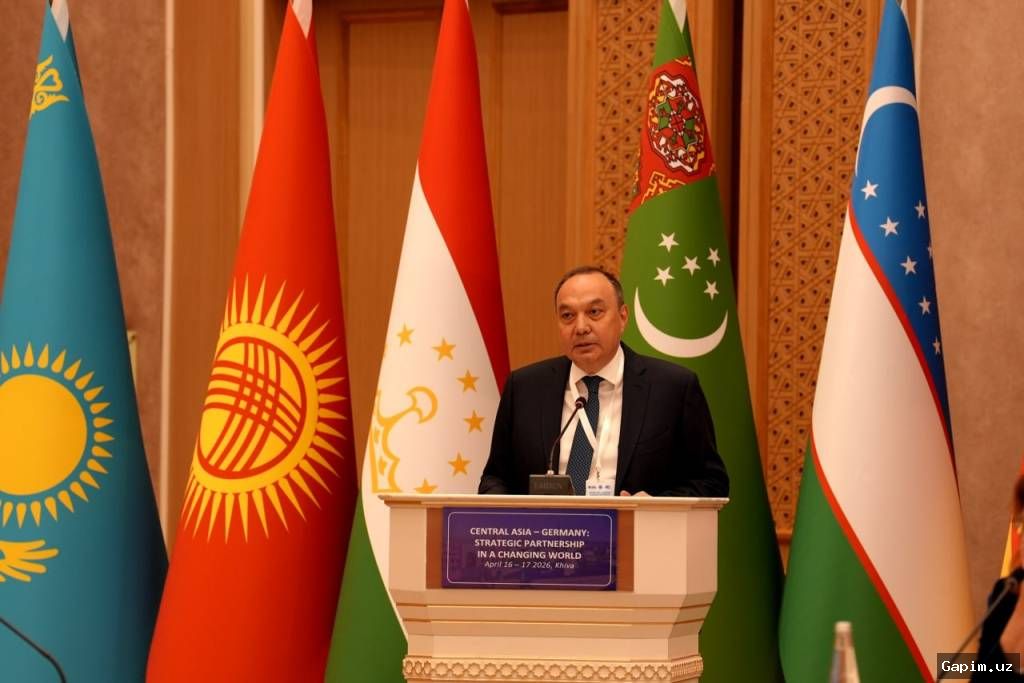
Last week, the “Central Asia — Germany” expert forum took place in Khiva. During the event, a discussion was held with Eldor Aripov, Director of the Institute for Strategic and Regional Studies. According to him, cooperation between Central Asia and Germany is currently entering a completely new stage. If previously the main focus was on expanding ties and implementing individual projects, a deeper and more substantive cooperation model oriented toward long-term results is now taking shape.
Aripov outlined three priority directions. The first is economic and technological cooperation. In this sphere, partnership is gradually moving away from the traditional “raw materials — finished products” model and is being directed toward jointly creating added value. Central Asia possesses the necessary conditions for such a transition: the region’s total GDP exceeds $560 billion, with annual growth rates stably maintained at around 6%. Germany, in turn, possesses a unique engineering school, production culture, and technologies that enable the creation of complex industrial systems.
The second direction is “green” transformation and resource management. Issues of water resources, energy, and climate change are directly linked to the region’s long-term sustainability. Germany has extensive experience in green transformation—from the introduction of renewable energy sources to the formation of complex management solutions in energy efficiency and regulation. Projects are being implemented with the participation of institutions such as KfW and GIZ, as well as specialized companies like Lahmeyer International.
The third direction is human capital development. Central Asia possesses significant demographic potential: by 2050, the region’s population could approach 100 million, while the share of youth remains high. From this perspective, the German model of vocational education, particularly the dual system that ensures an organic link between education and production, is of special interest. Currently, joint programs for training qualified personnel, developing vocational education, academic exchange, and scientific cooperation are being implemented with the participation of GIZ, DAAD, and Goethe-Institut.
Aripov noted that German partners have repeatedly emphasized that Germany is pursuing a measured and pragmatic policy in the region. Berlin does not aim to replace other partners and does not view Central Asia as an arena for geopolitical rivalry. On the contrary, it seeks to naturally complement the existing cooperation system, focusing on technological partnership, investment interaction, and sustainable development. For Central Asian countries, this approach is of fundamental importance, as the region is consistently shaping its distinctiveness not as a field of competition but as a space for cooperation.
The transport direction holds particular significance. Amid the transformation of global logistics, Germany is showing interest in reliable and diversified routes, while Central Asia is strengthening its role as a link between Europe and Asia. The discussion is no longer merely about transit but about forming full-fledged economic corridors supplemented by industrial and service components of logistics.
At the same time, differences persist between Germany and the countries of the region. For partners with different economic structures and development levels, this is natural. These differences are especially noticeable in approaches to the pace of energy transition and environmental standards. Germany operates based on the logic of accelerated decarbonization, while the regional countries proceed from the need to balance environmental tasks, energy security, and socio-economic stability. However, these differences do not serve as constraints but, on the contrary, add additional substance to mutual cooperation.
According to Aripov, the greatest untapped potential today lies precisely in those directions where cooperation has begun but has not yet reached a systemic level. First, this is the deep processing of strategic raw materials. Central Asia possesses significant reserves of copper, uranium, rare and rare-earth metals, which are critically important bases for green energy, electronics, and batteries. German companies are traditionally strong in equipment, chemical technologies, and engineering. Second, the digital economy and IT. On one hand, Central Asia is a rapidly growing labor market, where up to 1.5–2 million young specialists enter the job market annually. On the other hand, Germany faces a constant shortage of qualified personnel. Third, labor migration and the skilled labor market. Recent decisions by the German side to open about 800 vacancies for Uzbek nurses and paramedics in Germany are a very important signal.
Source: www.gazeta.uz