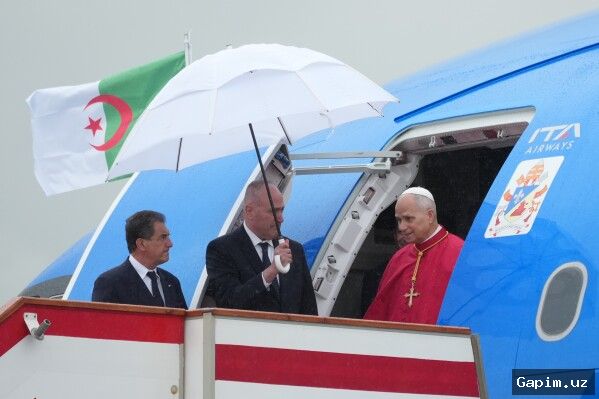
Pope Leo XIV has made his first papal visit to Algeria, marking the opening stop of an African tour with a call for peace and signaling the continent's growing importance to the Catholic Church. The 11-day trip, which includes stops in Cameroon, Angola, and Equatorial Guinea, is the longest by Pope Leo since his election to the papacy in May last year. According to academics and theologians, the choice to visit Africa sends a powerful signal that the continent is one of the church's top priorities.
Adriaan van Klinken, a professor of religion and African studies at the University of Leeds, said this reflects shifting demographics, with Africa home to one of the fastest-growing Catholic populations and accounting for about 20% of Catholics worldwide. In contrast, the Catholic population in Western Europe is in decline. Van Klinken stated, "Africa is the site of vitality, of growth, of the future of the church." John Pontifex from the Catholic charity Aid to the Church in Need UK reported that in the last year alone, 14 new dioceses have been created across Africa, with the Catholic population growing by 7 million. He added, "A focus on Africa this early on in Pope Leo's pontificate no doubt reflects a sense that in terms of Catholicism this is a continent that is coming of age."
Upon arrival at Algiers international airport on Monday, the pope was welcomed by Algeria's president, Abdelmadjid Tebboune. He was later taken to the Maqam Echahid, a monument commemorating those who died in the 1954-62 Algerian war for independence against French colonial rule. Father Peter Claver Kogh, rector of the Basilica of Our Lady of Africa in Algiers, described the visit as a moment to strengthen bonds between Christian and Muslim communities and solidify "the desire to have a climate of peace and tolerance among these two religions." He further said, "That is what the world needs now – a world of fraternal living and living in harmony. That will be the utmost importance of this visit for Christians and Muslims who are here, and all those who desire to live in peace and harmony."
For Austen Ivereigh, a biographer of Pope Francis, the trip signals continuity with his predecessor's priorities. In 2019, Francis broke new ground with the joint "human fraternity" document signed with leading Muslim figures. Ivereigh said, "Leo will want to continue that all-important alliance in building a new world order of peace." Pontifex noted that the trip is not just about interfaith relations but also a sign that the pope remains committed to freedom of religion and belief. He added, "His visit comes at a time when religious freedom in Algeria, be it for Christians, Ahmadi Muslims and more liberal Muslims, has declined in recent years, according to our research."
The trip has also been viewed as an opportunity to spotlight communities with long histories of injustice and exploitation who are often overlooked by the West. Lucy Esipila, regional coordinator for Caritas Africa, said she believes the pope's visit will have a profound impact on Catholic communities in the region. She stated, "At a time when many African nations continue to face conflict, debt burdens, and widening inequalities, this apostolic journey is a powerful expression of synodality, of 'walking together' as a global church that listens to voices from the peripheries." Algeria is the only Muslim-majority country on the pope's tour. While its Catholic population is relatively small, the country holds particular significance for Pope Leo as the birthplace of Saint Augustine. Leo is the first pontiff from the Augustinian order, a theological tradition emphasizing a commitment to "live together in harmony."
Professor Anna Rowlands, holder of the St Hilda chair in Catholic social thought and practice at Durham University, said, "Starting his visit in Algeria shows the other side of African Christianity that Leo is also deeply attuned to: its ancient legacy." North Africa was home to some of the earliest Christian communities before the arrival of Islam and remains central to the church's intellectual and theological heritage. Rowlands added that as the former head of the Augustinian order, Pope Leo (then Friar Robert Prevost) travelled frequently to African communities. She said, "The church in Africa is well known to him – probably better known than to any pope in the modern era."
The decision to make these African countries the focus of his longest trip so far as pope comes alongside his decision not to visit the US. Dr Miles Pattenden, a historian of the Catholic church at the University of Oxford, said, "That's the unspoken part of this." Pattenden noted that Pope Leo not only declined an invitation to the US but on 4 July, American independence day, he will be visiting the Italian island of Lampedusa, which is the place of arrival for many Africans making the perilous journey across the Mediterranean. Pattenden said, "He's sending an extremely powerful message, which President Trump obviously understands, and that may explain some of his bombastic criticisms of the pope over the past few days." This contrast appears to speak directly to the communities Leo is seeking to reach. Father Kogh said, "It's a feeling of joy," upon hearing Leo address the people of Algeria. "I'm so glad to have heard that message, because it was what I was expecting: a message of peace, and a call to coexistence and living in fraternity. So my joy redoubles."
Source: www.theguardian.com