Until recently, the Green Party was on the fringe of British politics. Between 2010 and 2024, it had just one member of parliament. In the July 2024 election, which saw the implosion of the Conservatives and Labour’s rise to power under Keir Starmer, it managed to secure just four seats in parliament.
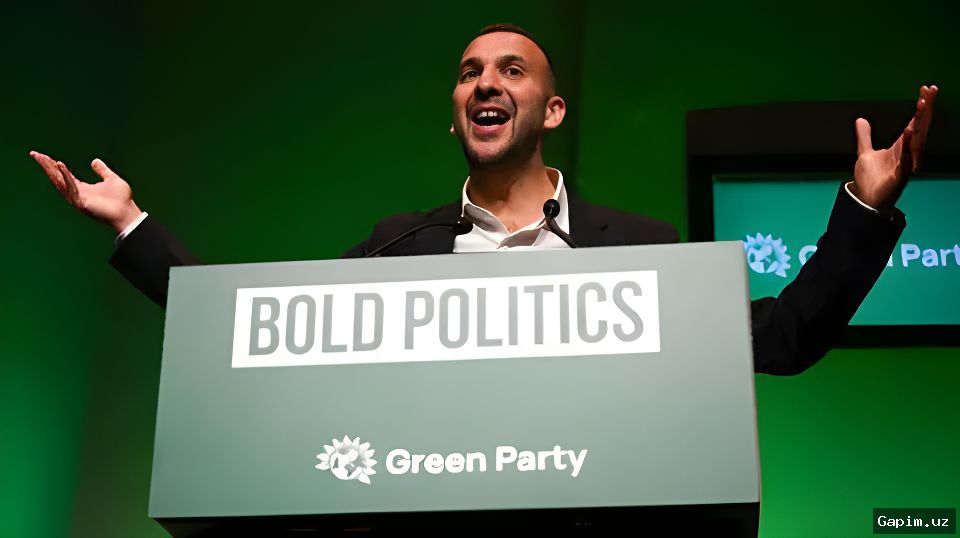
But the party’s fortunes began to change rapidly in the Starmer era. With the Conservatives and the Labour government now reduced to the mid-to-high teens in the polls, the economy on its knees, and anti-establishment sentiment growing across the political spectrum, the Greens have begun to emerge as a political force capable of challenging Nigel Farage’s Reform at the next general election. They are now polling at about 17 percent, level with the Conservatives and one point ahead of the governing Labour Party. They also won their first parliamentary by-election at Gorton and Denton, taking 40.6 percent of the vote. Membership has risen from 65,000 in July 2025 to about 220,000 today.
This shift is in no small part due to the party’s unapologetic support for Palestinians. Indeed, many leftists and progressives frustrated with the Labour Party’s support for and whitewashing of Israeli crimes in Gaza and the rest of occupied Palestine have voiced their support for the Green Party after Zack Polanski, a non-Zionist Jew who has unequivocally described Israeli actions in Gaza as a “genocide”, was elected leader in October 2025.
Polanski’s vocal support for Palestine and his consistent condemnation of Israeli crimes and excesses undoubtedly contributed to the party’s surge in support. But it has also triggered an anti-Semitism smear campaign almost identical to the one that eventually saw Jeremy Corbyn and his leftist, pro-Palestine supporters ousted from the Labour Party. How the Green leader responds will determine not only the future of his party, but potentially the direction of British politics.
The anti-Semitism smear campaign against the Greens began in earnest after the party’s by-election victory in Gorton and Denton, where 30 percent of the population is Muslim and the Greens put Gaza at the forefront of their campaign. The victory shocked the British establishment and forced many to accept that the Greens had become a genuine contender for power.
As a result, just as was the case with Corbyn’s Labour, Polanski’s Greens were immediately accused of “sectarianism” and promoting anti-Semitism for votes. The accusations of supposed anti-Semitism peaked after an attempt was made at the party’s Spring conference to pass a motion declaring “Zionism is racism,” which failed only due to filibustering by Jewish Greens.
About this time, the media began to push the line that those kicked out of Labour over supposed “anti-Semitism” during the Corbyn years had joined the Greens and transferred their “hateful” politics there. As the first Jewish person to be branded an “anti-Semite” and kicked out of the Labour Party back in 2018, and as a new member of the Green Party since March 1, the author was personally targeted to advance this argument.
On March 28, the Jewish Chronicle ran an article about the author joining the Green Party, suggesting his involvement “has fuelled fears that the party is becoming a magnet for those expelled from Labour during the height of its anti-Semitism crisis”. A similar article appeared in The Telegraph two weeks later. Since then, the so-called “anti-Semitism crisis” in the Green Party has become a narrative widely accepted as fact in the British media, and Zack Polanski has found himself standing where Corbyn once stood in 2018.
Polanski still has a real shot at carrying his party to power, but he could lose it all if he repeats Corbyn’s mistakes and tries to appease his bad-faith critics. Indeed, during the so-called “Labour anti-Semitism crisis”, Corbyn never once questioned the good faith of his Zionist accusers. Instead, he acted as their messenger, repeatedly apologised, promised to do better, and threw friends under the bus, eventually echoing his opponents’ narrative. His strategy of appeasement was a disaster.
Tragically, the Green Party leadership appears to have decided to implement Corbyn’s failed strategy of appeasement in its efforts to survive its own “anti-Semitism crisis”. On April 16, the author’s membership in the Green Party was suspended without any explanation beyond 11 words: “Documented history of anti-Semitism, including court decisions and recent terrorism charges”. Since then, at least 22 council candidates have been suspended over similar issues.
On April 29, two Jewish people were stabbed in Golders Green in North London by a man with a long history of mental health problems. The police declared the incident an act of terror, and Starmer swiftly linked the attack, with no evidence, to Palestine solidarity demonstrations. When Polanski retweeted an X post criticising police officers for “repeatedly and violently kicking a mentally ill man in the head” after he had already been incapacitated with a Taser, the Green leader found himself at the centre of a moral panic over anti-Semitism.
After the Commissioner of the Metropolitan Police wrote an open letter to Polanski criticising him for the retweet, a “senior Green Party source” told ITV News that “the test now is what action the leadership takes around candidates who have made anti-Semitic remarks.” The conservative press then intensified its smear campaign, with The Telegraph publishing the front-page headline “Polanski is an extremist, says Israel” on May 1, and the Daily Mail running with “Polanski’s Greens Are a Party of Poison.”
Speaking to the BBC on Sunday, Polanski condemned any anti-Semitic comments, saying this was “not an abstract idea” for him. “As a Jewish person, those comments disgust me. It’s important that we let the disciplinary process take its place, and that’s exactly what we have,” he said. He rejected the idea that anti-Semitism was something especially prevalent in the Green Party: “I don’t believe we have a particular problem compared with wider society and other political parties.”
Polanski seems to be following Corbyn’s failed playbook in dealing with this manufactured crisis. If he does not change course, the smear campaign will consume him, just as it consumed Corbyn. What Polanski needs to say clearly is that the overwhelming majority of these accusations are not cases of people hating Jews because they are Jews, which is what anti-Semitism actually is. Rather, they are cases of people, often clumsily, extending criticism of Israel into anti-Semitic tropes after decades of Zionist insistence on conflating the Israeli state with Jewish people as a whole.
At tomorrow’s polls, the Greens are expected to gain more than 500 seats, quadrupling the number they hold today, whereas Labour is expected to lose up to 75 percent of its 2,557 seats. The Greens are campaigning on a radical platform of taxing the wealthy, bringing utilities back into public ownership, ending new oil drilling, and supporting the Palestinians. The party, and its progressive platform, has never been this close to meaningful political power in Britain.
Whether it can maintain that momentum may depend on whether Polanski continues down the path of appeasement, or chooses instead to directly challenge what he and his supporters see as politically motivated accusations designed to neutralise pro-Palestine politics. If the Green Party continues purging anti-Zionist voices in an effort to satisfy its critics, it risks hollowing out the very movement that spurred its rise, transforming itself into just another establishment party, albeit one with a green tinge.
Source: www.aljazeera.com